Corrosion Barrier
The vinyl shell is the permanent corrosion barrier and finished face — the reinforcing steel inside never touches salt water.

A vinyl form on the outside, steel-reinforced concrete poured inside — concrete strength behind a corrosion barrier.
Reinforced concrete that never touches salt water
Truline panels are interlocking vinyl forms. We drive them like sheet pile, set the reinforcing steel inside, and pour concrete into the form.
The result is a reinforced concrete wall whose steel never touches salt water — the vinyl shell is the permanent corrosion barrier and the finished face. Two practical advantages matter on real properties. First, Truline can often be installed directly in front of an existing failing wall, turning the old wall into backstay and skipping demolition. Second, the forms cut and curve far more easily than large precast panels, which matters on lots with returns, radii, or pipe penetrations.
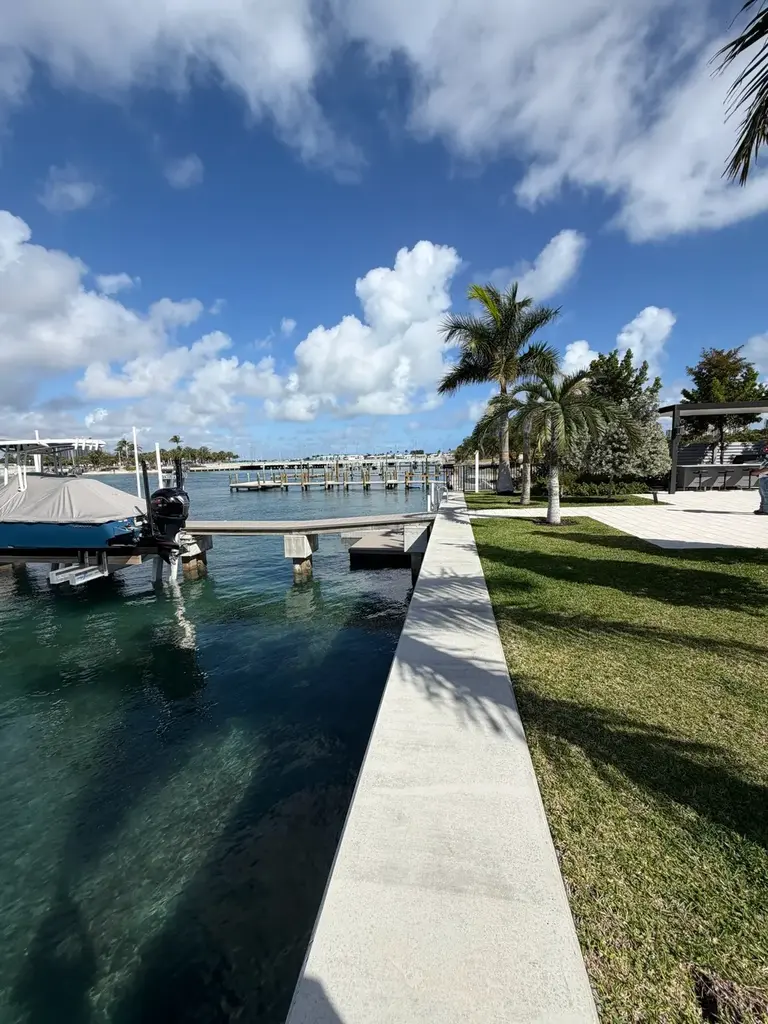
The vinyl shell is the permanent corrosion barrier and finished face — the reinforcing steel inside never touches salt water.
A poured, steel-reinforced concrete core gives Truline section strength comparable to conventional reinforced concrete.
Truline can often be installed directly in front of an existing failing wall, turning the old wall into backstay and skipping demolition.
A 50+ year vinyl shell paired with a concrete core whose steel is sealed away from salt water — each material covers the other’s weakness.
The forms cut and curve far more easily than large precast panels — which matters on lots with returns, radii, or pipe penetrations.
More than vinyl sheet alone, often competitive with full concrete replacement once demolition savings are counted.
Truline sits between our vinyl and concrete systems: more section strength than vinyl sheet alone, with corrosion protection conventional concrete can't match. It's a strong fit for failing-wall replacements where demolition is costly, and for owners who want concrete structure with a clean, uniform face. Not sure which system your property needs? Compare our vinyl seawalls and concrete seawalls, or see the full seawall construction overview.
Truline begins with interlocking vinyl panels driven into the ground like sheet pile. The panels are not a decorative skin: they stay in place as the permanent outside form and corrosion barrier. Reinforcing steel is placed inside that form, then concrete is poured into the cavity to create the structural core. The result combines a clean vinyl face with reinforced concrete section strength, while the steel is kept away from direct saltwater exposure.
That hybrid construction changes how the wall can fit a real property. The forms can cut and curve around returns, radii, and penetrations more easily than large precast pieces. Where site rules and engineering allow, Truline can also be built in front of a failing wall, using the existing structure as backstay instead of assuming full demolition. The inspection and design still have to confirm feasibility. For the cost factors behind each option, compare the seawall cost guide.
Vinyl sheet pile is often the straightforward residential choice when corrosion resistance, marine-borer resistance, and low maintenance are the priorities. It is a good fit when the wall geometry and required section strength can be met without a concrete core.
Truline makes sense when the project benefits from concrete strength behind a vinyl barrier, or when curves and building in front of an existing wall may reduce demolition. It occupies the middle ground, not a universal upgrade.
Reinforced concrete can suit high-exposure or commercial conditions that call for substantial mass and a specific structural design. Chloride protection, rebar cover, crack control, elevation, and drainage become central to the choice. Compare the full concrete system.
We begin by inspecting the existing wall, measuring the shoreline, reviewing access, and identifying the elevation and permitting requirements. Engineering sets the wall line, embedment, reinforcement, tie-back layout, and cap detail. After approvals, the crew mobilizes from land or water, drives the interlocking forms, installs the reinforcing steel, and places the concrete core. Backfill, grade restoration, cap finishing, cleanup, and final inspection complete the system.
Each step matters because the hybrid wall only performs as a system. A good panel line cannot compensate for weak tie-backs, poor embedment, or an elevation detail that does not match the property. That is why the initial scope should account for the existing wall and adjacent dock at the same time. If you are comparing replacement paths, start with the new seawall construction process and request an inspection rather than choosing from a material sample alone.