Salt & Corrosion Proof
Vinyl is completely impervious to saltwater corrosion, the primary cause of concrete seawall failure in South Florida's marine environment.
The seawall material that holds up best in South Florida's saltwater. Corrosion-proof, marine borer resistant, and built to last 50+ years.
Why Most South Florida Seawalls Should Be Vinyl
Vinyl sheet pile is the most durable and cost-effective seawall material for South Florida's saltwater canals and Intracoastal waterfront properties.
We install marine-grade vinyl sheet pile systems built for our region's tidal conditions, sandy soil, and aggressive saltwater. Vinyl is impervious to the salt corrosion and marine borer damage that cause concrete seawalls to fail prematurely. The result is a wall that outlasts concrete by decades with a fraction of the maintenance. Every installation is custom-designed, fully permitted, and built with reinforced concrete caps and stainless tie-back systems.
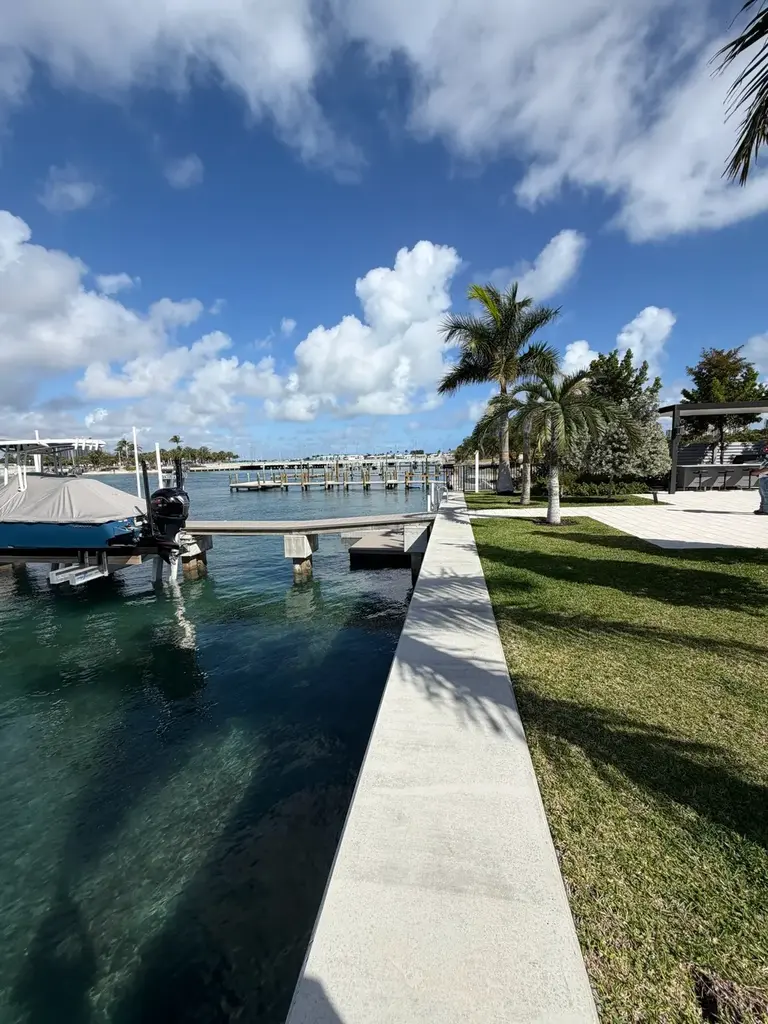
Vinyl is completely impervious to saltwater corrosion, the primary cause of concrete seawall failure in South Florida's marine environment.
Unlike wood or untreated concrete, vinyl sheet pile cannot be attacked by marine boring organisms common in South Florida waterways.
Properly installed vinyl seawalls in South Florida routinely last 50 to 75 years with minimal maintenance, far longer than concrete in saltwater environments.
No painting, sealing, or annual treatment required. Vinyl retains its structural properties and appearance with only occasional cleaning.
Vinyl sheet pile panels are driven efficiently with vibratory equipment, reducing construction time and waterfront disruption compared to poured concrete.
Higher upfront cost than some alternatives is offset by dramatically lower lifetime maintenance costs and a service life that often outlasts the property mortgage.
Site Assessment
We evaluate your shoreline, soil conditions, water depth, tidal range, and existing structures to engineer the right vinyl system for your property.
Material Selection
We specify the vinyl profile, wall height, cap design, and tie-back configuration based on site conditions and engineering requirements.
Permitting
All municipal, county, and DEP permits are filed and managed by our team, including engineering drawings and environmental documentation.
Installation
Our crew drives vinyl sheet pile panels using vibratory equipment, installs tie-back and deadman anchor systems, and pours the reinforced concrete cap.
Completion
Final inspection, backfill and grade restoration, site cleanup, and full warranty documentation before we hand the keys back to you.
“Vinyl” is not one universal wall. Section modulus describes how the profile resists bending; a higher requirement may call for a different profile, embedment, or support layout. Wall thickness affects the section and the way panels handle driving and exposure. Those specifications have to be matched to the wall height, soil, water pressure, and tie-back design rather than selected from color or face appearance.
UV inhibitors protect the exposed vinyl face from the South Florida sun, but they do not eliminate the need to specify the product for marine use. Tie-back spacing determines how the wall transfers load into the soil behind it; spacing that looks economical on paper can be wrong for the wall geometry or soil conditions. We review the section modulus, wall thickness, UV protection, embedment, and tie-back spacing together, then coordinate the cap and adjacent dock. For a material comparison, see Truline and the seawall cost guide.