No Splinters, No Sealing
No annual sealing or staining, no rot in the boards, and color that is engineered into the material instead of painted on.

Capped composite decking on pressure-treated framing and wrapped pilings — the low-maintenance dock, with its trade-offs stated plainly.
Pay up front, or pay in maintenance forever
No splinters, no annual sealing or staining, no rot in the boards, and color engineered into the material instead of painted on.
Over a decade of South Florida sun and salt, that maintenance delta is most of the argument — composite costs more on day one and typically less to own. The trade-offs, plainly: composite runs hotter underfoot than wood in full summer sun, and board quality varies widely between products — uncapped or partially capped boards can swell and fade in constant-moisture marine use. We spec fully capped boards rated for marine environments and install them with hidden fasteners, and we'll tell you which products we won't put on a dock.
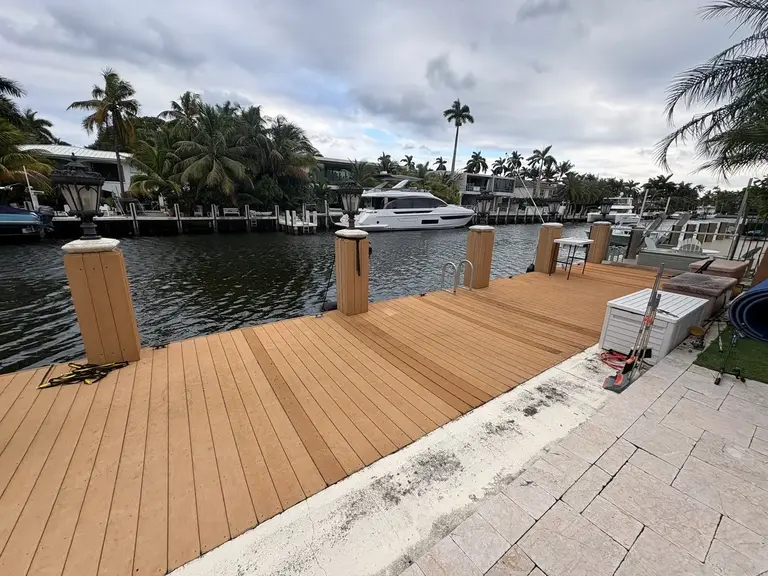
No annual sealing or staining, no rot in the boards, and color that is engineered into the material instead of painted on.
Composite costs more on day one and typically less to own — over a decade of sun and salt, that maintenance delta is most of the argument.
We spec fully capped boards rated for marine environments and install them with hidden fasteners — and tell you which products we won't put on a dock.
Pressure-treated framing sized for your loads, stainless hardware, and pilings driven to refusal and wrapped. A premium deck on a tired substructure is money wasted.
Quality capped boards carry manufacturer warranties of 25 years and up against rot, splintering, and fade.
Composite runs hotter underfoot than wood in full summer sun. Lighter colors help — and we show you the options side by side.
Under the boards: pressure-treated framing sized for your loads, stainless hardware, and pilings driven to refusal and wrapped. A premium deck on a tired substructure is money wasted — if your framing or piles need work, the estimate says so before any boards go down. Weighing your options? Compare wood docks and floating docks, or read more about pilings and the full dock construction process.
Capped composite puts a protective shell around a composite core. It resists rot and splintering, holds color better than an exposed board, and usually needs rinsing instead of annual sealing. It can run hot in direct South Florida sun, and darker colors make that trade-off more noticeable. A textured surface can improve footing and reduce slip risk, but the product still needs to be chosen for wet use.
PVC is a cellular plastic decking material with no wood fiber. That can make it easy to clean and resistant to water absorption, but heat, surface texture, expansion, and appearance vary by product. Ask how the boards perform when wet, in full sun, and around the fasteners. PVC can be the right answer for a maintenance-focused dock when the product and framing are specified together.
Wood has a familiar feel and can stay more comfortable under bare feet in sun, but it asks for regular cleaning, sealing, and board replacement as the waterfront weathers it. It can be a sensible choice when the owner accepts that maintenance cycle or wants a particular natural look. We compare it with the wood dock structure beneath it.
A composite surface cannot correct undersized framing or a piling that has lost section. We inspect the substructure, size the pressure-treated framing for the expected loads, and plan the connections so the deck and the structure move together. Stainless steel hardware is a strong corrosion-conscious option for many exposed connections. Hot-dip galvanized hardware can also be appropriate when its coating, location, and compatibility with surrounding materials fit the design. The detail matters at every joist, ledger, bracket, and piling connection.
Saltwater, sun, boat wake, and wet-dry cycling are a system test. We keep the decking decision tied to the framing and piling condition so the finished dock does not look new while the structure underneath remains the weak link. When a repair is more appropriate than a full replacement, see our dock repair process.
Composite decking is low maintenance, not no maintenance. Rinse away salt and organic buildup, keep leaves from holding moisture against the boards, and follow the product's cleaning guidance rather than using an aggressive cleaner that can change the surface. Watch the fasteners and the framing connections after storms, especially where the dock meets the seawall or lift. Fading is usually a product and exposure question; color engineered through the board performs differently from a surface coating.
The deck's service life is set by more than the board warranty. Pilings, joists, hardware, drainage, and the way the dock is loaded all matter. A regular visual check catches loose boards, movement, corrosion, and soft framing before a small maintenance item becomes a structural repair. For a new project, we price the surface, substructure, and access separately so the long-term decision is clear.