
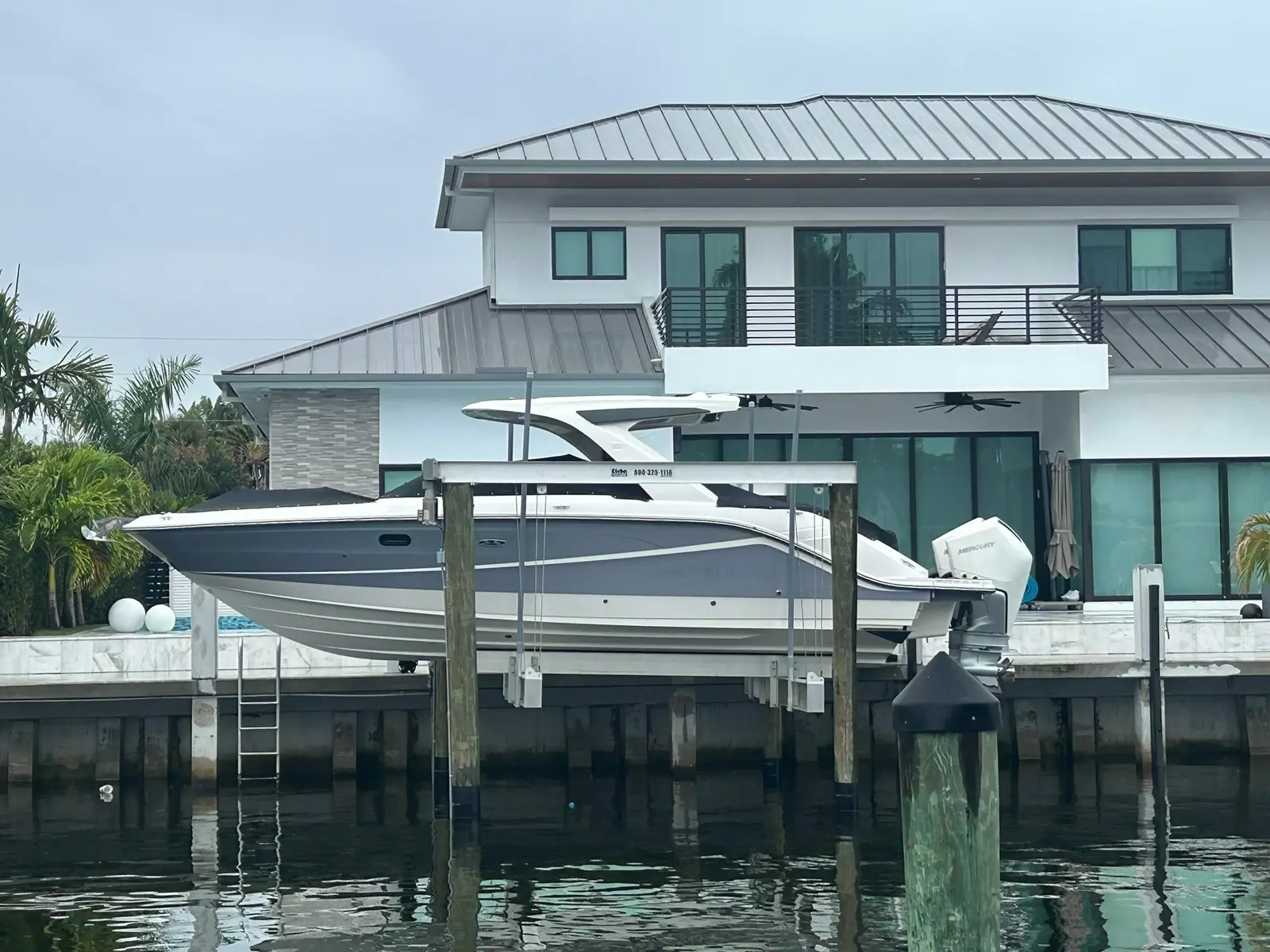
A boat lift that clicks, hums, or stops halfway through a lift is not necessarily a dead motor. The fault may be in the supply, controls, drive, or loaded lifting system. The useful first step is to stop operating it and describe what happened, not to keep pressing the switch until something moves.
This guide separates safe observations from work that belongs to a technician. It is not a wiring or capacitor-replacement tutorial. Salt exposure, summer rain, and long electrical runs to canal docks make professional diagnosis especially important in Broward and Palm Beach County. For hands-on diagnosis and repair, use our boat lift repair service.
First: make the situation safe
Release the control and keep people off the boat and away from the suspended cradle. Do not stand beneath the hull, climb onto beams, or enter the water to investigate. If there is smoke, a burning smell, exposed wiring, storm damage, or water in electrical equipment, leave the system alone. Disconnect power only from an accessible, dry location where it is safe to do so; otherwise keep clear and get professional help.
Neptune’s maintenance guidance says not to operate a lift with damaged wiring, tripped breakers, moisture inside control boxes, intermittent motor operation, or failing controls. Treat a breaker or GFCI trip as information for an electrician, not an invitation to reset it repeatedly. Never bypass protection, increase breaker size, or connect an extension cord as a test.
No sound and no movement
Silence does not prove the motor has failed. A power outage, interrupted supply, remote problem, control fault, or limit-switch condition can all leave a lift unresponsive. From the dry dock, record whether nearby equipment also lost power, whether the remote indicates anything, and whether the problem began after rain, an outage, or recent service. Do not open a panel to look for a loose wire.
Identify the lift and control models from labels that are safely visible. The right operating sequence depends on that equipment. Hi-Tide’s model-specific manuals include separate lift and remote-control instructions; a generic internet reset sequence may not fit yours. Follow only owner-level procedures for your exact model, and do not cycle a suspect lift simply to compare remote and local operation.
The motor hums, clicks, or starts slowly
A hum without movement needs a stop, not a longer button press. Possible causes include a starting-component fault, inadequate supply voltage, or resistance in the mechanism. These are possibilities for a professional to distinguish, not a diagnosis you can make from the sound. Repeated stalled starts can add heat while leaving the original problem unresolved.
Supply problems deserve attention before buying a replacement motor. Hi-Tide’s FAQ specifically warns about inadequate power supplies and running lifts on extension cords. Ask an electrician to verify the supply against your equipment requirements, including conditions under load. Do not assume another manufacturer’s voltage recommendation applies to your lift, and never change motor wiring yourself.
If the discussion turns to a capacitor, leave its housing closed. Stored electrical energy can remain after power is disconnected. A capacitor swap based only on humming can miss a supply or mechanical problem and expose the owner to an avoidable hazard.
The breaker or GFCI trips
Note when the trip occurred: after a storm, as the lift started, or while it was already moving. That history helps a qualified electrician separate possible moisture or insulation problems from other electrical faults. You do not need to reproduce the trip to provide useful information. A photograph of an accessible device label is more helpful than another attempt to lift the boat.
Do not dry a flooded control box with a heat gun or resume operation because the outside looks dry. Keep power off pending assessment of storm-affected equipment. Neptune identifies electrical inspection as part of a complete annual service; a lift technician and electrician may need to coordinate rather than treating the motor as an isolated appliance.
The motor runs, but the cradle does not rise
Motor noise with little or no lifting points the inspection toward the connection between the motor and the load. Depending on the lift design, a technician may examine the gearbox, coupling, belt or other drive components, cable winding, and obstructions. Grinding or an obvious change in sound is a reason to leave the system stopped.
Do not reach toward a turning drive, remove a guard, push a pulley, or try to help the cradle along. Do not test the system with a different boat or add people to change its balance. Before any diagnostic movement, the technician needs to decide how to secure the vessel and whether it can be safely launched or needs separate support.
One side moves, or the lift stops at one height
Stop both motors if one side lags, the cradle tilts, or a cable looks slack. Continuing on the working side can worsen the imbalance. Never compensate by cycling one motor independently or adjusting cable tension yourself. Photograph the condition from a safe position without walking onto the lift.
A lift that stops at the same height may be reaching an intended travel limit, or it may have a control, winding, or mechanical problem. Do not bypass a limit switch to find out. Explain whether the stopping point is new and whether the boat, bunks, or controls changed recently. Model-specific travel settings and safe clearance belong in the professional assessment.
What to send before a service visit
Good information makes boat lift motor repair more focused. Send existing photos or safely take new ones from the dock; never restart a faulty lift just to film it. In a narrow canal, mention dock access and whether the boat blocks safe access to the machinery. Include the last successful use and whether anything changed afterward.
- Equipment: lift brand, model, rated capacity, and motor or control labels visible without removing covers.
- Symptom: silence, clicking, humming, grinding, protective-device trip, uneven travel, or failure in one direction.
- Boat and position: vessel model, recent load changes, whether it is on the lift, and whether the cradle appears level.
- History: storm exposure, outages, last service, recent electrical work, and any previous repairs.
Ask who will handle electrical diagnosis and how the boat will be supported during repairs. Do not promise to lower it before the visit if operation is already unsafe. South Florida Seawall can review the situation and plan access through our service inquiry page.
Repair the motor, or replace the lift?
Request a written cause of failure, the proposed parts, and the condition of the surrounding system. A replacement motor must suit the drive, controls, supply, and manufacturer’s requirements; horsepower alone is not enough. If the underlying problem is inadequate supply or binding machinery, replacing the motor without addressing it leaves the cause in place.
Broader replacement becomes a different conversation when the frame, pilings, cables, gearboxes, and controls also need substantial work, or your current boat exceeds the system’s suitable capacity. Compare an itemized repair with a correctly specified replacement using our installed boat lift cost guide, rather than comparing a bare motor price with an entire installed lift.
After the repair, ask for operating instructions, any warranty conditions, and a service record describing the fault and correction. Keep that record with the model manual. Our saltwater boat lift maintenance checklist covers the routine checks that follow; troubleshooting should end with a documented repair, not a new habit of coaxing a struggling motor into motion.