
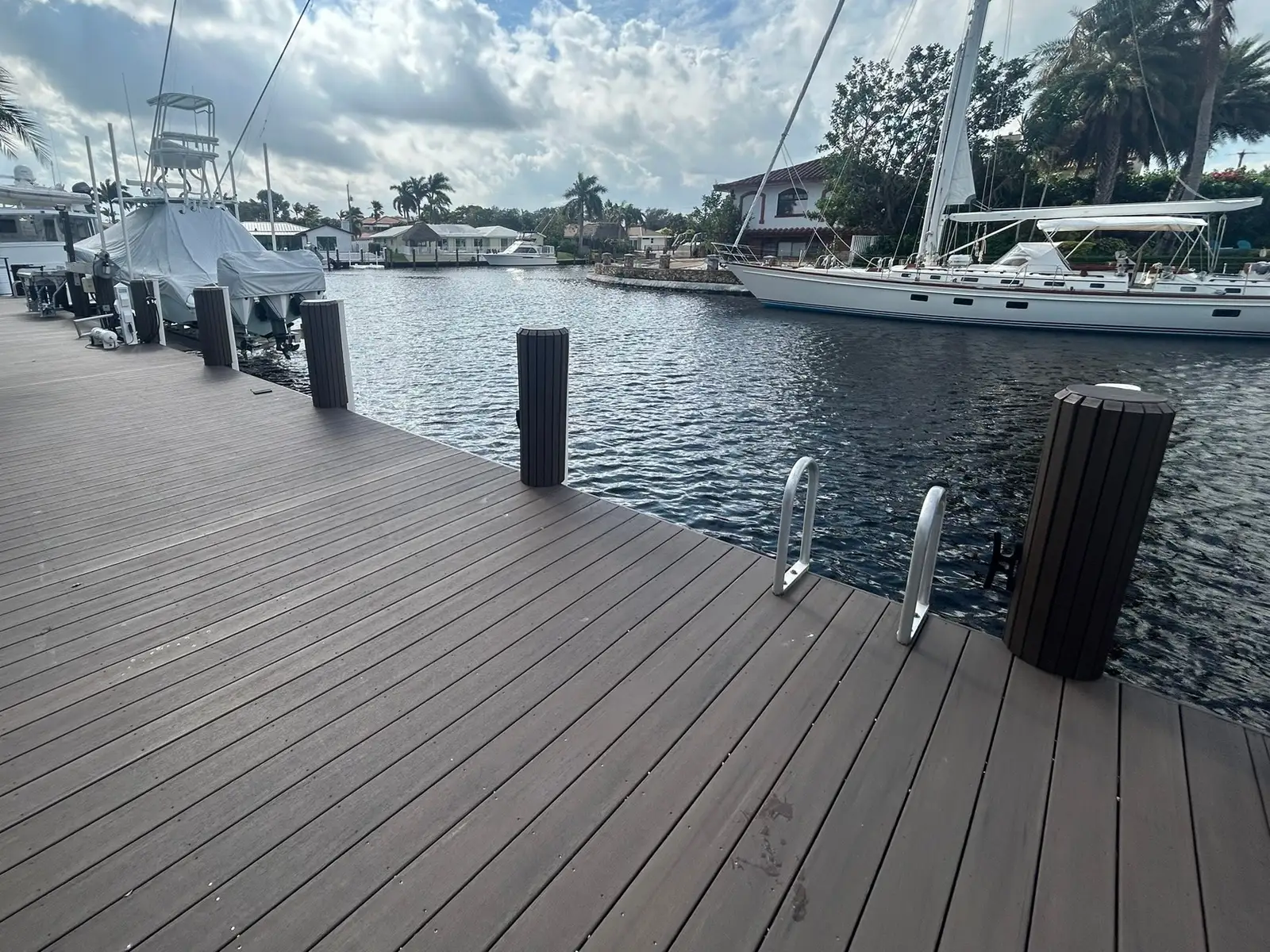
A dock can look perfect from the deck and still be standing on pilings that are half gone. In Broward and Palm Beach County the damage almost always starts below the waterline, where marine borers and constant wetting work on the pile out of sight, and it only shows up topside once the dock starts to move.
This guide explains what attacks pilings in South Florida, how to inspect your own at low tide, and how the three main repair options (wraps, jackets, and replacement) compare. It is written so you know what you are looking at before you talk to a contractor. For the installation side of the story, including the materials we drive and how we work from the water, see our dock piling installation and replacement page.
Why pilings fail faster in South Florida
Marine borers never get a winter off. Florida Sea Grant researchers point out that the water here never gets cold enough to kill wood borers or seriously slow them down, and that two of the main borers in Florida are unusually hard to stop: the gribble Limnoria tolerates standard creosote treatment, while the isopod Sphaeroma is quite tolerant of chromated copper arsenate (CCA) treatment (Florida Sea Grant via NOAA). In other words, the two most common preservatives each have a local pest that shrugs them off.
The borers do damage in two different ways. As the University of Florida's IFAS extension describes, some marine borers tunnel deep into the wood and greatly reduce its structural strength, while others make shallow tunnels that leave the surface vulnerable to being worn away by wave action (UF/IFAS). The deep tunnelers hollow a pile from the inside while the outside still looks solid. The surface attackers produce the classic hourglass shape, where a pile narrows sharply in the band between low water and the mud line.
South Florida is its own treatment zone. The American Wood Protection Association's use category system puts salt and brackish water south of Georgia in a separate category, UC5C "Southern Waters," specifically because borers such as Martesia and Sphaeroma are present (AWPA Standard U1). Wood treated for northern waters is not the same product. When a wood pile is specified for a canal in Fort Lauderdale or Boca Raton, it should be treated for this exposure, and if you are replacing piles it is worth asking what category the new ones are rated for.
Concrete piles have a different enemy. Borers do not eat concrete, but salt water drives chlorides into it and corrodes the reinforcing steel inside. The rust expands, cracks the concrete along the line of the steel, and eventually pops pieces off. The pattern is the same one we describe for seawall caps in our cap repair guide: straight cracks, rust staining, then spalling and exposed steel.
How to inspect your pilings at low tide
You can learn a lot from the dock and from a kayak or paddleboard on a low tide. Go pile by pile and note what you find.
- Necking or hourglassing. Any pile that is visibly thinner near the waterline or the mud than it is at the top has lost section there. The narrower the neck, the less load the pile can carry.
- Soft or hollow wood. Press a screwdriver into the wood in the tidal zone. Sound wood resists; wood that lets the tip sink in or sounds hollow when tapped has internal damage.
- Holes and tunnels. Small holes at the surface can be the only outward sign of borers working inside the pile.
- Split or rotted tops. Water sitting in an uncapped pile top rots it from above, and the dock framing is bolted right there.
- Cracks, rust stains, or spalls on concrete piles. These point to corroding steel and should be assessed before they progress.
- Movement. A dock that sways, bounces, or shifts when a boat wake hits it, or a boat lift that no longer sits level, is telling you a pile has lost capacity or embedment.
- Loose or corroded hardware. Through-bolts and brackets connecting the framing to the pile are part of the structure. Corroded hardware can fail even when the pile is sound.
Much of the damage sits below the surface, so a topside look is a screening, not a diagnosis. Our marine inspections include below-waterline checks of the piles with photos, so you know what you are standing on before you spend money on decking or a lift above it.
Option 1: Piling wraps (protect a sound pile)
A wrap is a sheet of plastic, commonly PVC or HDPE, sealed tightly around the pile from above the high-water line down into the bottom. It works by cutting borers off from the oxygenated water they need and blocking new larvae from settling on the wood.
Wraps are prevention. They make the most sense on piles that are still structurally sound, such as a relatively new wood dock or piles that have just been replaced. A wrap cannot put back wood that is already gone. Wrapping a pile that has already hourglassed simply hides the problem, which is why an inspection should come first.
Option 2: Pile jackets (restore lost section)
A jacket is a rigid form, typically PVC or fiberglass, installed around the damaged pile with a gap between the jacket and the wood or concrete. The bottom is sealed at or below the mud line and the gap is filled with grout or concrete. The fill takes up the voids left by borers, rebuilds the lost cross-section, and the jacket then protects the repair.
Jacketing is an established method in Florida well beyond residential docks: state environmental rules include a specific exemption for local governments and the state transportation department to repair existing concrete bridge pilings with pile jackets, provided the permanent outer form is made of inert material (Rule 62-330.051, F.A.C.). On the residential side, products such as Shoreline Plastics' SnapJacket are extruded PVC shells that open, snap around an existing pile without taking apart the structure built on top, and are then filled with concrete; the manufacturer's installation guidance calls for cleaning marine growth and soft material off the pile first and jetting the sand out at the bottom so the fill reaches below the mud line (Shoreline Plastics).
Jackets are the right call when a pile has lost meaningful section but is still standing in the right place, the framing connections at the top are sound, and there is enough good material to work with. For a pile that supports a boat lift or other heavy concentrated load, the jacket and fill should be designed for that load rather than chosen off the shelf.
Option 3: Replacement (when there is not enough pile left)
Some piles are past repair: broken, rotted through at the top, hollowed so badly that a jacket would be doing all the work, or no longer embedded deeply enough to resist movement. Those need to come out and be replaced.
Replacing a pile under an existing dock is routine marine work, not a dock rebuild. The deck is opened up locally around the failed pile, the old pile is pulled or cut, a new pile is driven, and the framing and decking are restored. Because the work is done from the water, having a crane barge that can reach the canal matters as much as the pile itself. Replacement is also the moment to upgrade: a borer-resistant material, a properly rated treated pile, or a wrap installed on day one.
How to choose: the questions that decide it
- How much section is left? Little or no loss favors a wrap. Moderate loss with sound wood or concrete elsewhere favors a jacket. Severe loss, breaks, or rot through the top favor replacement.
- What does the pile carry? Lift piles and piles under heavy equipment deserve a more conservative answer than a pile under a walkway.
- Is it one pile or a pattern? Piles driven at the same time in the same water tend to age together. If several are showing damage, plan for the set rather than chasing one at a time.
- How old is the rest of the dock? Spending heavily on piles under framing and decking that are near the end of their life may not be the best use of the budget. Sometimes the honest answer is a rebuild.
- Is the dock still functional? That affects permitting, as explained below, and it affects safety. A pile that has let go under a lift is an urgent repair, not a maintenance item.
If your pile problems come with other issues, such as damaged decking, loose framing, or storm damage, our dock repair team handles the whole structure in one scope. If the concern is a lift that has started to rack or sit unevenly, see boat lift repair; lift problems and pile problems are often the same problem.
Concrete and other marine piling repair
The same three options apply to concrete piles, with one difference: the damage is driven by corroding steel, not borers. A wrap does little for a concrete pile, because the problem is already inside it. Small, isolated spalls above the waterline can be patched once the loose concrete is removed and the exposed steel is cleaned and treated. Cracking or section loss in the tidal zone is where a grout-filled jacket earns its place, since it rebuilds the pile and seals the repaired zone from the salt water that caused the damage. A concrete pile that is cracked through, badly out of plumb, or has lost much of its steel is a replacement.
Boat lift piles, mooring piles, and fender piles fail the same ways as dock piles and are repaired the same ways, but the load each one carries changes the answer. A mooring pile that a boat leans on in a storm, or a lift pile carrying a 20,000 lb boat, needs a more conservative repair than a pile under a walkway. For new and replacement piles under any of these structures, see our marine piling repair and replacement services, all driven from our own barge.
Permits for piling repair and replacement
At the state level, Florida's Environmental Resource Permitting rule exempts the replacement or repair of existing docks and piers, including mooring piles, provided the existing structure is still functional or was rendered non-functional within the last year by a discrete event such as a storm, flood, accident, or fire (Rule 62-330.051(5)(d), F.A.C.). That timing matters: a dock that has been left collapsed for more than a year after a storm may no longer fit the exemption.
The state exemption is only one layer. Municipal building departments typically permit structural dock work, and Broward and Palm Beach County each have their own environmental review for work in tidal waters. Requirements vary by address, so your contractor should confirm them before the barge shows up rather than after.
What to do this month
Walk the dock at the next low tide with a screwdriver and a phone. Photograph every pile at the waterline, probe the tidal zone, and note any movement you feel when a boat goes by. If everything is solid, consider wraps on the piles that are not yet protected; prevention is far cheaper than repair. If you find necking, soft wood, or cracked concrete, get the piles inspected below the waterline before deciding between a jacket and a new pile.
South Florida Seawall inspects, jackets, wraps, and replaces dock and lift pilings across Broward and Palm Beach County, working from our own barge. Call 754-SEA-WALL or use our contact page to schedule a visit.
Sources
- Florida Sea Grant (NOAA Institutional Repository) — Wood-Boring Marine and Estuarine Animals in Florida, SGEB-15
- UF/IFAS Extension — PI276: Wood Preservatives
- American Wood Protection Association — Standard U1: Use Category System (excerpt)
- Florida Administrative Code Rule 62-330.051 — Exempt Activities (Environmental Resource Permitting)
- Shoreline Plastics — SnapJacket Marine Repair Piling