Most seawall problems in Broward and Palm Beach County announce themselves at the cap. Long before a wall leans or a yard starts sinking, the concrete beam along the top shows a hairline crack, a rust-colored streak, or a corner that has popped off. Those are cheap to ignore for a year and expensive to ignore for five.
This guide explains what the cap does, why caps fail in salt water, how to tell a cosmetic crack from a structural one, and how to decide between spot repair and a new cap. It is written for waterfront owners who want to understand what they are looking at before they call a contractor, whether that is us or someone else. When you are ready for a hands-on assessment, our seawall inspection covers the cap, panels, tie-backs, and the ground behind the wall in one visit.
What the seawall cap actually does
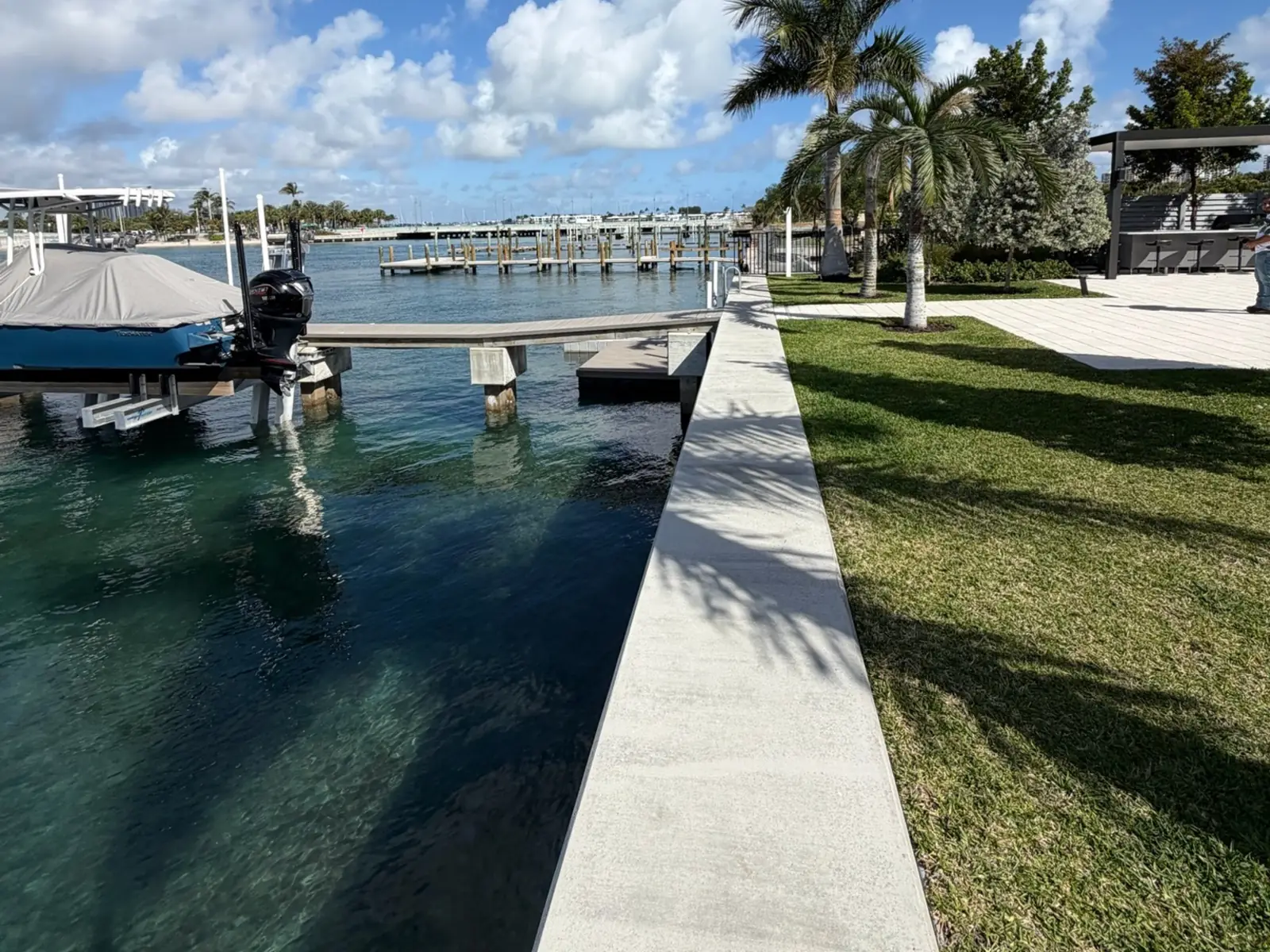
A seawall is not one piece of concrete. On a typical South Florida canal wall, individual panels (concrete, vinyl, or a hybrid like Truline) are driven or set side by side, and a reinforced concrete beam is then formed and poured across the top of all of them. That beam is the cap.
The cap has three structural jobs. First, it ties the panels together so that soil and water pressure on one panel is shared by its neighbors instead of pushing a single panel out of line. Second, it anchors the tie-back system: steel rods run from the cap or upper wall back to deadmen or anchors buried in the yard, and it is the cap that holds the waterward end of those rods. Third, it provides a stable, level surface for everything that gets attached to the waterfront later, including dock ledgers, cleats, ladders, railings, and boat lift columns.
A cap that has lost its steel is no longer tying the wall together, no matter how solid the panels underneath still look.
Why caps fail in South Florida
The cap lives in the worst possible spot for reinforced concrete: repeatedly splashed by salt water, baked dry in the sun, and wetted again on the next tide. That wet-dry cycle drives chlorides into the concrete faster than constant submersion would.
Reinforcing steel inside healthy concrete is protected by a thin passive film that forms in the alkaline environment of the cement. Chloride ions break down that film. Once the steel begins to corrode, the rust it produces occupies far more space than the original metal did. A 2024 review in RSC Advances puts the volume of corrosion products at roughly two to six times the volume of the steel they replace, and notes that cracking of the concrete cover can begin at very small corrosion depths (Royal Society of Chemistry). That expansion is what pushes the cover concrete off the bar. The visible result is a crack that follows the line of the rebar, a rust stain bleeding from that crack, and eventually a spall, where a chunk of concrete lets go and exposes the bar.
Several things accelerate the process on a canal-front cap:
- Thin concrete cover. Older caps were often poured with the steel closer to the surface than current practice calls for, so chlorides reach the bar sooner.
- Attached hardware. Every cleat bolt, dock ledger anchor, and lift column base is a path for water to reach the steel. Corroding hardware also stains and cracks the concrete around it.
- Tie-back corrosion. Where the tie-back rod passes into the cap, the rod itself corrodes, swells, and splits the concrete from the inside.
- Movement of the wall. If panels are settling or the wall is rotating, the cap gets bent along its length and cracks across, not just along, the steel.
- Washout behind the wall. When soil migrates out through panel joints or under the toe, the cap loses the backing it was designed against and begins to overhang voids.
How to read what you are seeing
Not every crack is a problem. Here is how we sort them on an inspection, from least to most concerning.
Fine, dry shrinkage cracks. Hairline cracks that run in random directions, are not staining, and do not change from year to year are usually from the original cure. They are worth sealing to keep water out, but they are not a sign that the cap is failing.
Straight cracks with rust staining. A crack that runs parallel to the length of the cap, sits a few inches in from the edge, and has brown or orange staining is almost always corroding rebar. The cap is telling you exactly where the steel is. This is the point at which repair is still straightforward and inexpensive relative to what comes next.
Spalling and exposed steel. Once concrete has broken away and you can see the bar, the corrosion is well advanced. The exposed section will now corrode faster, and the crack typically continues along the bar under intact-looking concrete on either side. Patching only the visible hole rarely lasts.
Cracks around tie-back locations. Radiating cracks, a bulge, or a rusty stain at regular intervals along the cap point to the tie-back rods. If the rod has lost enough section, the wall behind that point is no longer anchored, and you may see the cap bow toward the water between anchors.
Displacement. A cap that has dropped, tilted toward the water, or separated from the panel below is a wall problem, not a cap problem. The same is true of a lawn that slopes down toward the wall or sinkholes appearing along the cap. In those cases the cap is the symptom, and the assessment has to include the panels, the toe of the wall, and the soil behind it. Our seawall repair page covers what those structural repairs involve.
Repair options, from least to most invasive
Crack sealing and injection. For cracks that are not yet spalling, epoxy or polyurethane injection fills the crack, restores some section, and most importantly stops the salt water from reaching the steel. This is the least expensive fix and the one most often skipped until it is too late.
Spall repair. Where concrete has come off, the loose material is chipped back to sound concrete and continued around the bar so the steel can be cleaned or, if it has lost too much section, supplemented. The bar is treated with a corrosion inhibitor and the area is rebuilt with a marine-grade repair mortar that bonds to the old concrete. Doing this well is mostly about preparation; the patch itself is the easy part.
Partial cap replacement. If a run of the cap is spalled on multiple faces or the steel is gone, the cap is cut out between sound sections, new steel is doweled into the existing panels and the neighboring cap, and a new section is formed and poured. This is common at corners, at dock connections, and around old tie-back points.
Full cap replacement. When damage runs the length of the wall, or when the cap has to be raised, the entire cap is demolished and re-poured, usually with new tie-backs installed at the same time. On a concrete seawall with sound panels this can add decades of life. On a wall with failing panels it is money spent on the wrong component, and an honest contractor will tell you so.
Permits and the new height rules
Cosmetic patching usually does not require a permit. Cap replacement, tie-back work, or anything that changes the height or footprint of the wall does, and in South Florida there are two layers to think about.
At the state level, Florida's Environmental Resource Permitting rule exempts certain seawall work from a full permit, including restoration of a seawall damaged by a discrete event within the past year and repair or replacement in the same location, with limited allowance to move waterward as measured from the face of the existing wall, and construction or repair in artificial waterways with only the backfill needed to level the land behind the wall (Rule 62-330.051, F.A.C.). Whether a specific job qualifies is a determination your contractor should confirm rather than assume, and in Palm Beach County the Department of Environmental Resources Management also reviews work along the shoreline (Palm Beach County ERM).
At the local level, Broward County adopted a regional resilience standard for seawalls that municipalities were required to implement in their own codes. Under the county's model ordinance, new or substantially repaired tidal flood barriers, which explicitly include seawall caps, must be built to a minimum top elevation of 5 feet NAVD88, with applications before January 1, 2035 permitted at 4 feet NAVD88 if the wall is designed to be raised to 5 feet by 2050. The ordinance also makes failure to maintain a seawall in good repair a citable offense, with a timeline for the owner to complete repairs (Broward County Regional Resilience Standard for Seawalls).
The practical consequence is that a full cap replacement in Broward is often also a cap raise, which changes the forming, the amount of concrete, and how the dock meets the wall. It is worth knowing that before you get quotes, so you are comparing like with like. Municipalities in Palm Beach County have their own elevation and permitting requirements, which we confirm case by case.
The trend behind these rules is measurable: NOAA's long-term tide gauge at Virginia Key documents a steady rise in relative sea level for the South Florida coast (NOAA Tides & Currents). Higher water means more frequent wetting of the cap and more pressure on the wall during king tides.
Repair or replace: the questions that decide it
- Are the panels sound? No cracks, no leaning, no soil coming through the joints. If yes, cap work is worth doing on its own.
- Are the tie-backs intact? If they cannot be verified or are visibly corroded, plan on replacing them with the cap.
- How much of the cap is affected? Isolated spalls favor spot repair. Damage at multiple locations along the length usually means the whole cap has reached the same age and condition.
- Does the cap need to be raised? If your municipality's elevation rule applies, replacement may be required regardless of condition once you cross the substantial-repair threshold.
- What else is planned? A new dock or boat lift that will anchor to the cap is a strong argument for fixing the cap first rather than bolting new equipment to failing concrete.
For a sense of what these options cost in Broward and Palm Beach County, see our seawall cost guide, which we keep current with local pricing so that we are not repeating numbers here that will be out of date next season.
What to do this month
Walk the wall at low tide and photograph the cap from the water side if you can. Note any staining, any crack you can fit a credit card into, any spot that sounds hollow when tapped, and any low spots in the lawn along the wall. Then look again after a king tide. If water is coming through or over the cap, you have a maintenance obligation as well as a repair need.
If what you find is limited to a few stained cracks, sealing them now is the cheapest seawall work you will ever pay for. If you are seeing exposed steel, displacement, or anything at the tie-back points, get the whole wall assessed before deciding what to do about the cap. South Florida Seawall inspects and repairs caps, panels, and tie-backs across Broward and Palm Beach County, and for canal and basin bulkheads our bulkhead repair team handles the same scope. Call 754-SEA-WALL or use our contact page to schedule a visit.
Sources
- Broward County — Regional Resilience Standard for Seawalls and Shorelines (Chapter 39, Article XXV)
- Florida Administrative Code Rule 62-330.051 — Exempt Activities (Environmental Resource Permitting)
- Palm Beach County Environmental Resources Management — Permitting and Regulation
- RSC Advances (2024) — A review on chloride induced corrosion in reinforced concrete structures
- NOAA Tides & Currents — Sea Level Trends, Virginia Key, FL (Station 8723214)