
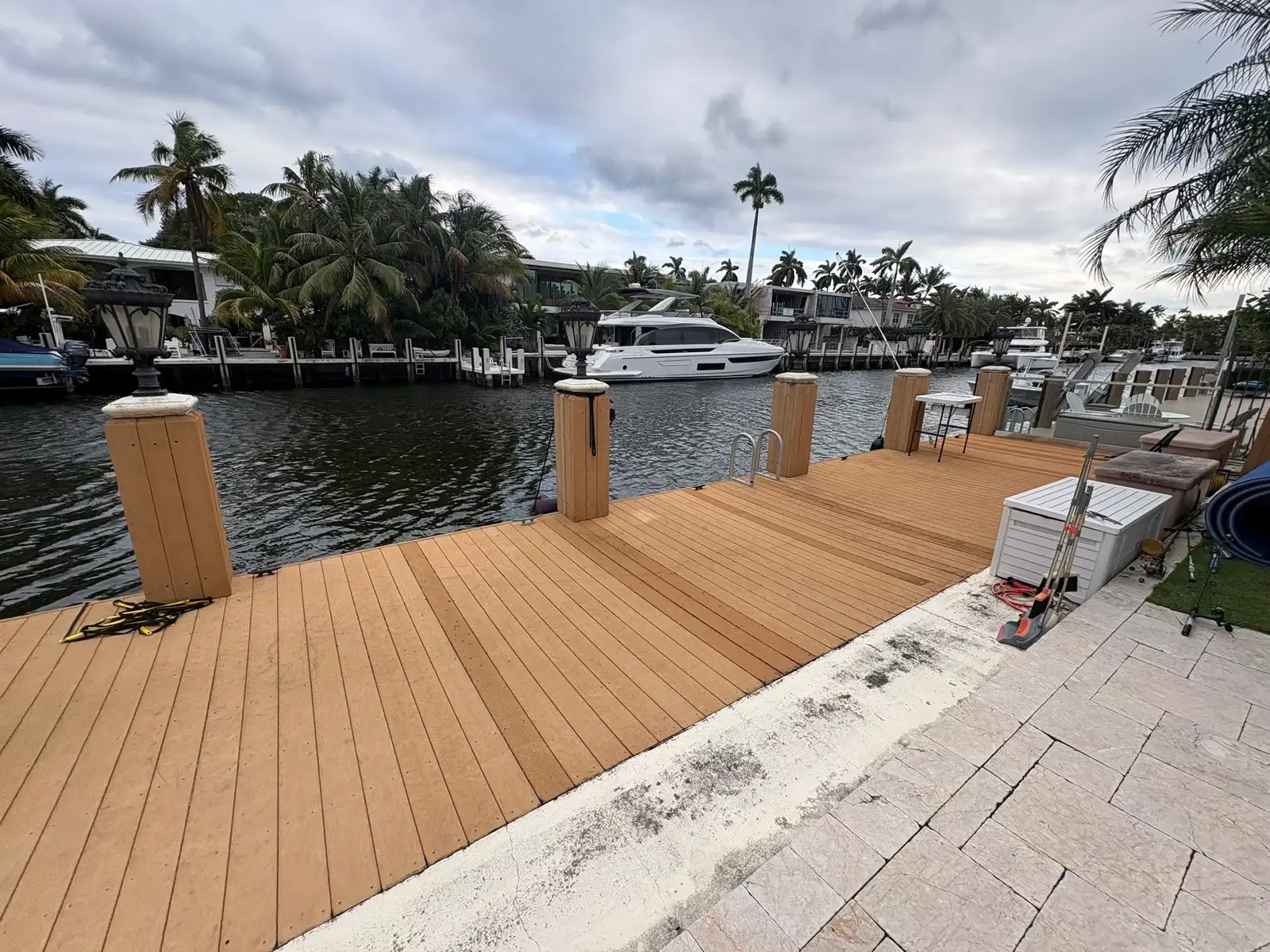
A floating dock moves with the water; a fixed dock stays at its designed elevation. That simple difference changes boarding, anchoring, maintenance, and storm planning. For a Broward or Palm Beach property, the better choice depends on the actual canal or Intracoastal frontage—not a claim that one type always handles tides or hurricanes better.
Start with how you will use the waterfront. A kayak launch, a drive-on jet ski port, and a walkway beside a large boat need different heights, loads, and connections. Our floating dock systems and dock construction services are installation options; this guide explains how to compare them before choosing a layout.
Floating dock vs fixed dock: the practical trade-offs
- Boarding height
- A floating deck follows the water, keeping its height above the water broadly consistent under its designed load. A fixed deck stays still, so the step down to a boat changes through the tide.
- Walking surface
- A fixed structure avoids the movement inherent in a float. A floating dock's motion depends on its size, loading, connections, and exposure; do not judge it from an unloaded display unit alone.
- Support
- A floating system needs flotation and an anchoring or guide arrangement. A fixed dock transfers loads through its designed supports, which may include piles and an approved seawall connection.
- Access from land
- A floating system generally needs a transition that accommodates movement. A fixed dock's land connection can stay level, but that does not solve the changing step between dock and boat.
- Storm exposure
- Neither label establishes storm performance. Design water levels, waves, wind, debris, travel limits, and connection capacity must be considered together.
Tidal range: Broward and Palm Beach canals are not all alike
Do not assign one tidal range to every South Florida dock. A canal's connection to the Intracoastal, distance from an inlet, local restrictions, and weather can affect the water you actually see. A sheltered finger canal may have less wake without having negligible water-level change. Intracoastal frontage adds a different exposure question: the same dock must deal with both changing water levels and passing traffic.
Use NOAA tide predictions to find a relevant station, then have the designer relate those predictions to site observations and the survey datum. Check ordinary low and high water, seasonal high-water conditions, and the design levels required for the project. Astronomical predictions are not a storm-surge allowance.
At low water, a floating dock must still have enough depth below its floats, enough guide travel, and a usable gangway. At high water, check clearance under adjacent structures and whether the land connection remains usable. For a fixed dock, compare the proposed deck elevation with the boat's boarding point across the expected range. A comfortable step during one afternoon visit does not establish year-round access.
Wake exposure and structural support come before decking
On an Intracoastal-facing property, ask how the proposed system handles repeated wakes, vessel contact, and movement at its connections. On a quieter canal, check whether turns, nearby traffic, or reflected wakes still load the slip. A floating system needs manufacturer and engineering limits appropriate to that exposure; a fixed structure needs adequate support and connections too. Neither should be selected solely because its decking looks sturdy.
Seawall-attached and piling-supported are not synonyms for floating and fixed. A floating dock may use guide piles or an engineered connection to shore. A fixed dock may rely on piles, a seawall connection, or both. The important question is where each load goes. Attaching brackets to an old concrete cap does not establish that the wall can support them.
Before reusing a seawall connection, inspect the cap, panels, anchors, and signs of movement. A seawall inspection can help identify conditions requiring engineering review. If the design uses piles, discuss condition, location, embedment requirements, and clearances with the installer; our marine piling services cover that part of the installation. Avoid treating the new deck as a cosmetic upgrade independent of its foundation.
ADA, kayak, and PWC access: look at the whole route
A low floating deck can make reaching a kayak easier, but the transfer still needs a stable arrangement, suitable handholds, and a manageable gap. For personal watercraft, distinguish a walking dock from a drive-on port. Check the port's fit for the specific craft, loading limits, approach clearance, and how the rider reaches it. Our jet ski dock options address that separate use case.
Accessibility also starts before the water's edge. A floating deck that tracks the tide can leave a steeper gangway at low water. Gates, surface transitions, turning areas, and clear space beside a boat may matter as much as freeboard. Check the route under realistic loading and water conditions, rather than describing a float as automatically wheelchair-accessible.
The U.S. Access Board's boating-facilities guide explains accessible routes, gangways, slips, and specific exceptions. Requirements depend on the facility and applicable law; do not assume every private residential dock has the same obligations as a public boating facility. Have a qualified designer establish applicability and the actual dimensions. For a home, discuss the user's mobility and transfer needs even when public-facility rules do not govern the project.
Permitting: floating does not mean permit-free
Start approvals before ordering a system. Florida DEP's Environmental Resource Permitting guidance explains coordination between DEP and the water management districts, including docking facilities and submerged-land authorizations. Which agency reviews the project depends on its circumstances. An environmental exemption, if applicable, does not by itself answer every building, ownership, or navigation question.
For a Broward address, identify the city or unincorporated-county building authority and ask which environmental reviews apply to the proposed dock. In Palm Beach County, the ERM permitting and regulation office describes its environmental review role; municipal approvals may also apply. Confirm the responsible offices for the address rather than assuming county-wide permission.
Bring a survey, existing permit information, a proposed layout, dimensions, anchoring details, and any planned piling work. Ask about property boundaries, navigation clearance, habitat, utilities, and submerged-land consent. Have the reviewer confirm the applicable approval or exemption path in writing. Changing from fixed to floating—or keeping the same footprint—does not establish that the old authorization covers the new work.
Maintenance and hurricane considerations
A floating dock adds moving connections to the inspection list: hinges, guide rollers or collars, anchoring hardware, flotation, and the land transition. Check for abnormal movement, rubbing, damaged floats, loose connections, and a gangway that binds as water levels change. Follow the manufacturer's inspection and cleaning instructions; a plastic surface does not make its hardware or anchoring maintenance-free.
On a fixed dock, inspect decking, fasteners, framing, piles, and the seawall interface. Soft spots, shifting supports, or corroded connections need assessment before they become a fall or structural hazard. For either system, keep electrical work with a qualified professional and address slippery surfaces without using a cleaning method that damages the material. Our dock repair team can assess an existing structure before you decide to replace it.
Normal tidal travel is not hurricane capacity. The National Hurricane Center distinguishes surge from predicted astronomical tides and explains the added hazard of waves. A floating system can run out of guide travel or damage its connections; a fixed deck can face overtopping, wave impact, and uplift. No universal deck height or dock type guarantees survival.
Use the BoatUS hurricane planning resources to organize a boat plan before warnings arrive. Coordinate with the dock manufacturer, engineer, insurer, and storage provider. Remove or relocate components only where the system's approved instructions allow it. Do not improvise storm attachments to the seawall or dock, and do not inspect from the dock during unsafe conditions. After a storm, keep people off a damaged structure until it has been assessed.
How to choose before requesting a quote
- Define the use. List boats, kayaks, PWC, passengers, mobility needs, and whether a stationary walking surface or low boarding height matters most.
- Document the site. Record low/high-water access, depth, frontage, exposure, survey elevations, existing supports, and utility locations.
- Compare complete designs. Include flotation or framing, anchoring, piles, seawall work, transitions, electrical scope, permits, and maintenance access—not just deck area.
- Review lifecycle obligations. Ask for inspection instructions, replacement-part availability, warranty exclusions, and a realistic storm plan.
There is no reliable universal price winner. The supports, access, engineering, and site work can change the comparison. Request a site-specific scope through our dock construction service instead of comparing an equipment-only float price with a complete fixed-dock installation. If the existing dock is sound, ask whether an access modification can meet your needs before assuming the whole structure must go.
The practical choice: consider floating when following water levels and low boarding are central and the site can support the movement and anchoring. Consider fixed when a stationary platform and the proposed structural arrangement better suit the property. In either case, approve the water-level, exposure, support, access, and permit plan together.