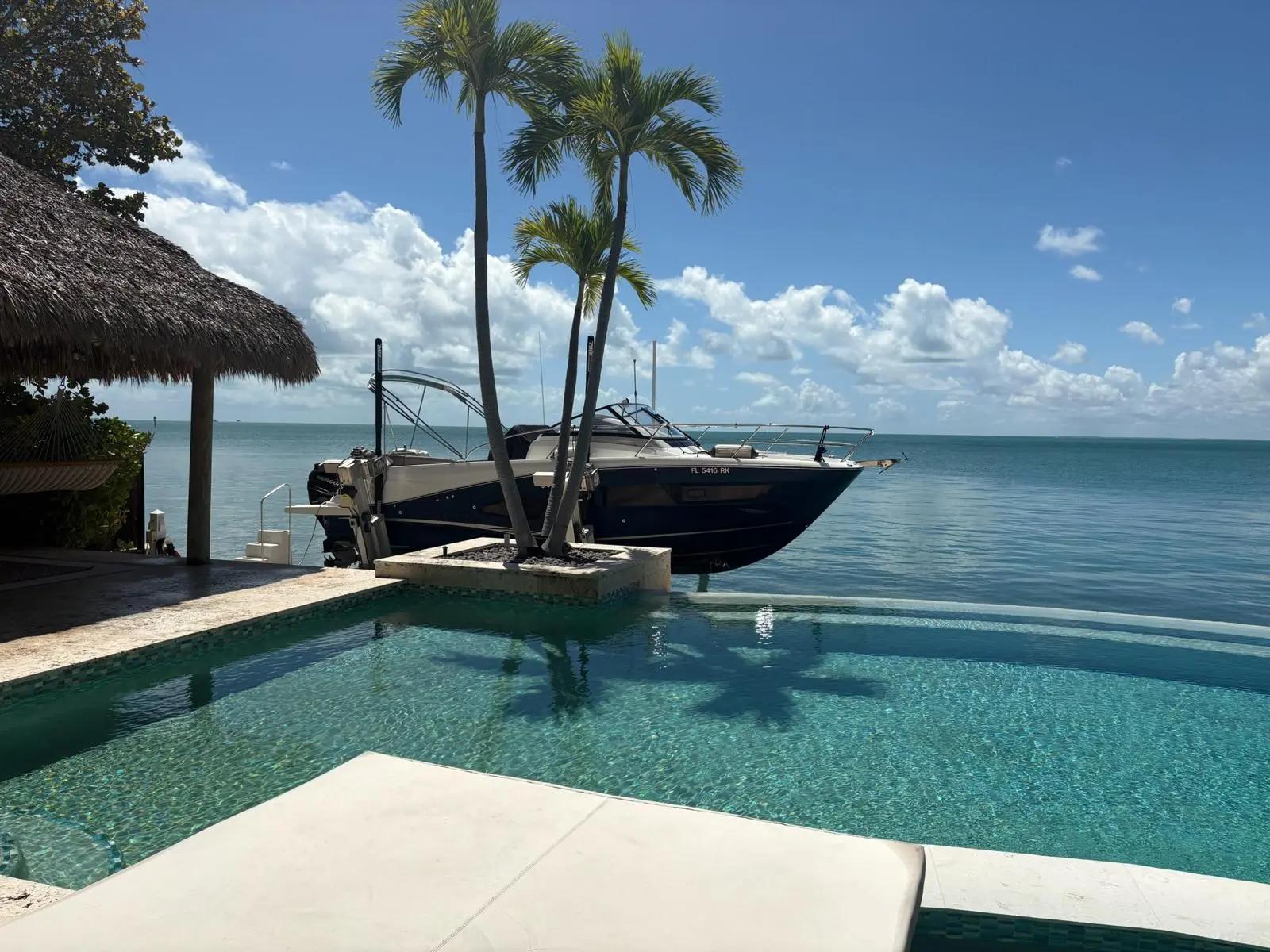
A saltwater boat lift is a mechanical system — mounted to pilings, a seawall, or the seabed, or floated on buoyant chambers — that raises a vessel above the water for storage, protecting the hull from marine growth, corrosion, and storm chafe. In Broward and Palm Beach counties, where thousands of homes sit on tidal saltwater canals, a lift is less a luxury than basic hull protection: warm salt water never gives a hull a fouling off-season, and corrosion runs year-round.
This guide covers the lift types that work in South Florida's tidal canals, how to calculate the capacity you need, what installations cost in 2026, how Florida permitting really works, hurricane-season procedure, how long a lift lasts in salt water, and the maintenance schedule salt water demands.
Quick answers
| Question | Short answer |
|---|---|
| What does an installed lift cost? | Most residential installs: $12,000–$35,000. Large-capacity (24,000 lb+): $35,000–$75,000+ |
| How do I size it? | Wet load (hull + engines + fuel + water + gear) plus a 20–25% margin |
| Do I need a permit? | Yes — county and city approvals apply even when the project is state-exempt; allow 2–8 weeks |
| How long do cables last? | Galvanized: ~2 years in salt water. Stainless: up to twice as long |
| Hurricane on the way? | Max safe height, drain plug out, strapped fore and aft — and move the boat if surge could reach the hull |
| Is a portable boat lift a dock lift? | No — it is a land-based trailer-separation tool for hull work. Floating and freestanding lifts are the relocatable on-water options |
| How long will it last? | Marine-grade aluminum with stainless hardware, rinsed and serviced: typically 15–20 years, with cables and motors replaced along the way |
Why store a boat on a lift?
Storing a boat in the water invites four expensive problems. Barnacles and algae colonize the wetted hull, increasing drag and fuel burn. Fiberglass hulls left submerged can develop osmotic blistering as moisture migrates into the laminate. Saltwater immersion accelerates galvanic corrosion on outdrives, trim tabs, and through-hull fittings. And a moored boat can chafe, swamp, or sink at the dock in a storm.
Lift storage addresses all four at once — dry hulls don't foul or blister, hardware corrodes far more slowly in air, and in many cases owners can skip antifouling bottom paint entirely. If you're weighing the investment, we broke down what that saves per year against the lift's own upkeep. Modern lifts span roughly 1,000-pound personal-watercraft platforms to yacht cradles rated above 50,000 lbs, with remote controls, hydraulic drives, and solar-charged DC power now common.
Types of saltwater boat lifts used in South Florida
The right lift depends on your water depth, frontage, tidal range, and boat. These are the styles we install most across Broward and Palm Beach County:
- Four-post cradle lift
- The South Florida workhorse. Two beams ride on four pilings and cradle the hull. Handles most consoles and cruisers from roughly 7,000 to 30,000 lbs, and adapts to canal depths and tides.
- Elevator (single-pad) lift
- A vertical platform mounted to the seawall or a single pile structure. Good where there is no room for four pilings, on shallow frontage, or where a clean, low-profile look matters.
- No-profile / low-profile lift
- Motors and gearboxes tuck below the dock line so nothing rises above the deck. Popular on modern homes and where a view or setback rules out tall beam towers.
- Beamless / cantilever lift
- Cradle arms mount to the seawall with no outboard pilings, keeping the waterway clear. Suited to seawall-only frontage and narrower canals.
- PWC / jet ski lift
- Compact 1,200–1,800 lb platforms for personal watercraft, often installed alongside a main boat lift as a second unit on the same dock.
- Yacht & cradle platform lift
- Engineered units rated above 50,000 lbs for large yachts, with hydraulic drives and DC or solar power increasingly common on high-end installs.
Not sure which style fits your dock? Our boat lift overview compares four-post, elevator, and no-profile options side by side.
Portable boat lifts: what the term actually means
"Portable boat lift" gets searched constantly by South Florida owners, and it almost always means something different from what they picture. A portable boat lift is a land-based piece of equipment — typically a set of four hydraulic jacks or adjustable stands with hull pads — designed so one person can raise a boat off its trailer, roll the trailer out, and work on the hull, running gear, or the trailer itself. Think of it as a boat hoist for the driveway or boatyard, not the dock. Systems in this category are built for use on dirt, gravel, or concrete and are rated for roughly 6,000 to 12,000 lbs in total, with each jack carrying a quarter of the load.
Before these tools existed, separating a boat from its trailer meant a shop with a crane, forklift, or travel lift. A portable lift lets a trailer boater or mobile mechanic do bottom paint, transducer and trim-tab work, hull repairs, and trailer bunk or axle service at home. For the many Broward and Palm Beach owners who trailer a center console rather than keep it on a canal, that is a genuinely useful tool — but it solves a maintenance problem, not a storage problem.
On the water, the term is sometimes stretched to cover two lift styles that can be relocated:
- Floating lift
- Air-filled or polyethylene tanks under a frame raise the hull by buoyancy and ride up and down with the tide. Secured to a dock or piling rather than permanently installed, so it can be moved. Common in 5,000–25,000 lb capacities and useful where pilings are not an option.
- Freestanding (bottom-standing) lift
- Legs rest on the bottom in shallow water — typically under 10 ft — with no pilings driven. Works in soft, stable bottoms and can be pulled and repositioned. Less common on South Florida canals, where tidal swing, currents, and hard or dredged bottoms usually favor a piling-mounted cradle lift.
How to size a saltwater lift
Sizing starts with your boat's wet (fully loaded) weight — not the dry number on the spec sheet. Add up the bare hull, engines, a full fuel load (gasoline is about 6 lbs per gallon), fresh water (~8 lbs per gallon), batteries, and all the gear that lives aboard. Then add a 20–25 percent safety margin and round up to the next standard capacity your dealer offers.
A published dry weight commonly understates the real loaded weight by 30 to 45 percent on a rigged center console, so a boat listed at 9,500 lbs dry can roll onto the lift closer to 13,500 lbs. Size from the brochure and you will buy an undersized lift. Because a lift's capacity is fixed once installed, we generally recommend sizing for the boat you'll own in a few years rather than the one at your dock today.
What a saltwater boat lift costs in 2026
Installed price is driven mostly by capacity, lift style, and whether your site needs new pilings or seawall reinforcement. Most residential installs land between $12,000 and $35,000; large-capacity and yacht platforms run higher.
- PWC / jet ski lift
- $3,000 – $6,0001,200 – 1,800 lb
- Standard four-post
- $12,000 – $24,0007,000 – 16,000 lb
- Large-capacity four-post
- $24,000 – $45,00020,000 – 30,000 lb
- Elevator / no-profile
- $18,000 – $40,000Varies by frontage
- Yacht cradle platform
- $45,000 – $75,000+30,000 lb+
These are installed ranges, not quotes — new pilings, deep-water sites, upgraded stainless hardware, and remote or solar options all move the number. For a full breakdown of what drives the price, see our boat lift cost guide.
Permits in South Florida
Permitting trips up more owners than any other part of the project. The key point: even when a boat lift is exempt from a state environmental resource permit, county and city building approvals almost always still apply. You cannot assume "exempt" means "no permit."
Broward and Palm Beach County building departments review the structural side — pilings, attachment to the seawall or dock, and wind/load engineering. Municipal approvals add their own requirements, and homes on the Intracoastal or within an HOA or gated community often need extra sign-offs. Realistically, plan on 2 to 8 weeks depending on the jurisdiction and whether pilings are involved. We handle permitting as part of every install so the paperwork isn't your problem.
Cables, corrosion, and maintenance
Salt water is relentless, and the components that fail first are the ones under load and constantly wetted. Cables are wear items. Galvanized aircraft cable typically lasts about two years in constant saltwater service; stainless cable lasts roughly twice as long. Inspect them several times a year and replace at the first sign of rust, birdcaging, or a broken strand — never wait for a visible break.
A maintenance rhythm that keeps a saltwater lift healthy looks like this:
- Weekly
- Rinse the lift, cables, and cradle with fresh water to knock down salt buildup, especially after heavy use.
- Monthly
- Grease the drive components, check that cables are spooling evenly, and inspect bunks and straps for wear.
- Quarterly
- Inspect cables closely for corrosion and fraying, check pilings and hardware, and confirm the motor housing seals are intact.
- Annually
- Have the lift professionally serviced — full cable, drive, motor, and structural inspection with any wear parts replaced.
Sealed or submersible drive motors, stainless hardware, and aluminum beams all buy years of extra life in salt. If your lift is aging or the drive is struggling, our boat lift repair team can assess it before a failure drops your boat.
How long a saltwater boat lift lasts — and repair vs. replacement
Materials decide lifespan here. Marine-grade aluminum beams and cradles with stainless steel fasteners and sealed drives are the standard for a reason: rinsed and serviced on schedule, that combination is typically a 15-to-20-year structure on a South Florida canal. Galvanized steel frames, common on freshwater lakes up north, lose their zinc coating quickly in warm salt water and are rarely the right choice on tidal frontage. Powder-coated or anodized aluminum adds another layer of protection where the lift sits in the splash zone.
Because the wear items — cables, motors, gearboxes, bunks, switches, and remotes — are all replaceable, a lift with a sound aluminum frame is almost always worth repairing rather than replacing. Replacement makes sense when the beams or cradle are corroded through, the pilings are failing, or you have moved to a boat the lift can no longer carry safely. If you are in the second situation, size the new unit for the boat after this one; see our sizing guide for why. We install and service lifts across Broward and Palm Beach County, including Fort Lauderdale, Pompano Beach, and Boca Raton.
Hurricane-season procedure
When a named storm is coming, the goal is to keep your hull above surge and stop the boat from moving on the cradle. Do three things:
- Raise to max height
- Lift the boat to its maximum safe height so it clears projected storm surge with margin to spare.
- Pull the drain plug
- Remove the plug so wind-driven rain and spray drain out instead of adding hundreds of pounds of water weight.
- Strap fore and aft
- Tie the hull down to the cradle at bow and stern so it can't shift or lift off in high wind.
Sources
- Florida Administrative Code Rule 62-330.051 — Exempt Activities (Environmental Resource Permitting)
- Florida DEP — Submerged Lands and Environmental Resources Coordination
- Broward County — Building Code Services
- Palm Beach County — Environmental Resources Management
- NOAA National Hurricane Center — Storm Surge Overview
- BoatUS — Hurricane Preparation for Boats