
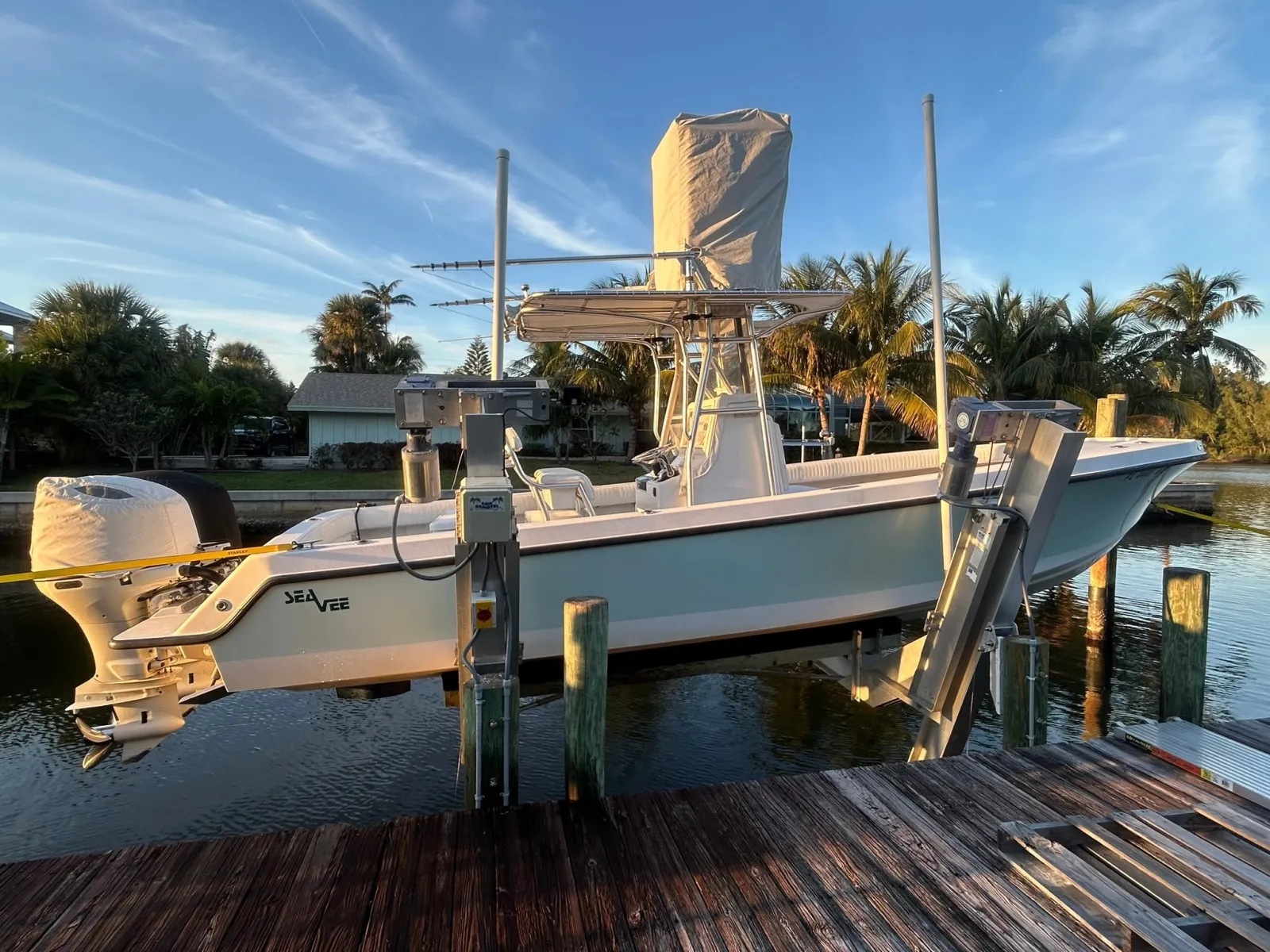
Waterfront owners have two basic ways to keep a boat at home: in the water at the dock, or dry on a lift. In South Florida the difference between those two choices is not a rounding error, because warm salt water never gives a hull an off-season — fouling and corrosion run twelve months a year, and most recurring marine maintenance exists specifically because a hull sits in the water.
We install and service lifts across Broward and Palm Beach County, so we see both sides of this ledger every week: the invoices in-water boats generate, and the service lives lifted boats get. Two ground rules for the numbers below. First, every figure is a current, checkable market rate — not a worst case. Second, we count the lift's own operating cost against the savings, because a comparison that leaves that out isn't a comparison.
1. Bottom paint: from a standing cycle to optional
Antifouling paint is a biocide-loaded coating that any boat left in the water needs below the waterline. The biocides deplete, so manufacturers like Interlux and Pettit put the repaint interval at 12–24 months — and in South Florida's fouling conditions, owners tend toward the annual end.
A realistic professional bottom job on a 25–30 ft boat includes haul-out, blocking, and pressure wash ($300–$800 at most yards), prep, and paint and application. All-in, a straightforward recoat starts around $900 and a full-service job runs to $2,000 or more; doing the painting yourself saves most of the labor but still requires the haul-out and some skill. Amortized across a one-to-two-year cycle, an in-water boat carries roughly $400–$1,600 per year in bottom-paint cost.
On a lift, the growth pressure that consumes the coating is gone. The same paint lasts 5–8+ years — and plenty of lifted South Florida boats skip bottom paint entirely, which also means a smoother, faster hull. Annualized cost: $0–$200.
2. Hull cleaning: the biggest recurring bill goes to zero
Even with fresh paint, a hull in South Florida water shows slime and the start of hard growth within two to three weeks. The standard remedy is a diver on a recurring schedule, and the market rate in Broward and Palm Beach for monthly service runs $2–$3.50 per foot — about $50–$105 per visit for a 25–30 ft boat. (First cleanings on a neglected hull, and hourly one-off jobs, cost considerably more; the schedule rate is what an in-water owner actually pays month to month.)
Frequency is what makes this the largest line item. Monthly service is the year-round baseline here, and many divers recommend twice-monthly visits May through September. At 12–16 cleanings a year, an in-water owner spends $600–$1,600 annually — every year, forever.
A lifted hull is dry. This bill is simply $0.
One related benefit we're deliberately not counting in the total: a fouled hull burns 15–25% more fuel. For an owner running 400–800 gallons a year, even a part-season fouling penalty is $150–$500 — but usage varies too much to average honestly, so treat it as upside.
3. Corrosion: slower depreciation on everything below the waterline
Continuous saltwater immersion accelerates galvanic corrosion on props, shafts, trim tabs, lower units, and through-hull fittings. Sacrificial anodes protect that hardware, but they deplete faster in the water, and even protected components age faster under constant immersion than under the few hours a week a lifted boat spends wet.
On boat lift and dock service calls we see the same pattern over and over:
- Propellers & running gear
- Life roughly doubles on a lifted boat versus the same hardware in constant immersion.
- Trim-tab actuators
- Units that fail at 5–7 years in the water routinely pass 10 years on a lift.
- Sacrificial anodes (zincs)
- Replaced every 6–12 months in the water; every 2–3 years on a lift.
- Lower units
- The fastest-aging part of the outboard fleet — far longer between seal and bearing work when not submerged around the clock.
Line by line, that's an in-water cost of roughly $400–$1,000 per year in parts and accelerated service, versus $100–$200 for a lifted boat.
4. Insurance: a rating factor, not a coupon
Here's the straight answer, because this topic gets overstated online: major marine insurers do not publish a standardized "boat lift discount." What they do — and state in their own rating-factor language — is price where and how the boat is kept. Storage type is part of underwriting, lifted boats present a better risk profile (elevated above surge, harder to steal, fewer immersion-related claims), and that can show up in the quote rather than as an itemized credit.
What's worth doing: tell your carrier the boat lives on a permanent lift, document it with photos or installer records, and ask specifically what it changes — and ask about hurricane haul-out and storm-preparation benefits, which several carriers genuinely offer in Florida.
Because the outcome varies by carrier and policy, we don't count insurance in the total below. If your premium drops, treat it as upside.
5. Theft and vandalism: a different risk profile
The National Insurance Crime Bureau reports 4,000–5,000+ watercraft thefts in the U.S. in recent years, with fewer than half — roughly 40% — ever recovered. Florida consistently leads the nation, and Miami and Fort Lauderdale have ranked among the top theft cities in the country. The boats that get taken are overwhelmingly the accessible ones: floating at docks and marinas, or sitting on trailers.
A boat on a lift is a different kind of target. Taking it means operating the lift or bringing equipment; an elevated hull is harder to board, harder to move, and easier to see from the house. This doesn't produce a tidy annual dollar figure — it shows up as claims that never happen and deductibles never paid — so, like insurance, we leave it out of the table and note it for what it is: a real reduction in exposure.
What the lift itself costs to own
Salt water works on lifts too, and an honest comparison subtracts that. From our own service schedules across Broward and Palm Beach: cables are wear items — galvanized aircraft cable lasts about two years in constant saltwater service, stainless roughly twice that — and a lift should get a professional inspection and service annually, with fresh-water rinses and greasing in between. Motors, gearboxes, and bunks are long-lived when that rhythm is kept.
All-in, budget $300–$600 per year: annual service, cable replacements amortized over their life, grease, and a trivial amount of electricity. Our boat lift repair and service team handles this on a scheduled basis for owners who'd rather not track it.
Any comparison that doesn't subtract this number is selling you something.
The honest total
For a typical 25–30 ft boat in South Florida saltwater:
| Category | In-water, per year | Lifted, per year | Difference |
|---|---|---|---|
| Bottom paint | $400 – $1,600 | $0 – $200 | $400 – $1,400 |
| Hull cleaning | $600 – $1,600 | $0 | $600 – $1,600 |
| Corrosion & parts | $400 – $1,000 | $100 – $200 | $300 – $800 |
| Subtotal, savings | $1,300 – $3,800 | ||
| Lift upkeep | — | $300 – $600 | −$300 to −$600 |
| Net annual savings | $700 – $3,500 |
Most owners land between $1,500 and $2,500 a year, with the high end belonging to boats on aggressive cleaning schedules and annual paint cycles. Insurance, fuel, and resale effects are additional and intentionally uncounted.
Payback — and what actually closes the gap
Price the lift correctly first. A rigged 25–30 ft boat's wet weight (hull, engines, full fuel and water, gear) typically calls for a 10,000–16,000 lb lift — see how to size a lift — and a standard four-post in that class runs $12,000–$24,000 installed in South Florida. Our boat lift cost guide breaks down what moves the number; $16,000 is a fair representative figure.
At typical net savings of $1,500–$2,500 a year, a $16,000 lift pays for itself in roughly 6–11 years. Light-use boats at low service rates can stretch past 15; boats on heavy South Florida service schedules can get there in about 5. Over a maintained lift's 25–30 year life, maintenance savings alone commonly total $30,000–$60,000 net of the installation — the lightest-use cases roughly break even, and the heaviest approach six figures.
If that were the whole story, a lift would be a good-but-slow investment. It isn't the whole story. Three things sit outside the table and do the real work:
- Resale condition
- Put a ten-year-old lifted boat next to the same model that lived in a wet slip: the hull, transom, and lower units tell the story before the survey does. Buyers and surveyors price condition, and a dry-stored history is worth real money at sale.
- Storm exposure
- A lifted boat rides out weather raised above normal surge, strapped to its cradle, drain plug out — instead of chafing and surging against a dock. Our saltwater lift guide covers the full hurricane procedure, including when the right answer is to move the boat entirely.
- Your time
- No diver scheduling, no yard queues, no haul-out logistics. Rinse, flush, done.
Waterfront agents commonly put a quality lift installation at $10,000–$30,000 of property value — treat that as directional rather than guaranteed, but it points the same way as everything above.
The bottom line
The maintenance gap between wet-slip and lift storage in South Florida is real, recurring, and quantifiable: $700–$3,500 a year net, driven mostly by hull cleaning and bottom paint, after honestly charging the lift for its own upkeep. On maintenance math alone, a right-sized lift typically repays its cost in 6–11 years and keeps paying for decades. Add what the table can't capture — a boat that holds its condition and value, a hull above the surge line, and hours back in your season — and for most owners here, the question stops being whether a lift makes sense and becomes which one, at what capacity.
The best starting point is your own numbers: what you actually spent on cleanings, paint, and running-gear work over the last twelve months.
References
- BoatUS — boat maintenance guidance and marine insurance information
- Interlux and Pettit — antifouling application and repaint-interval guidelines
- National Insurance Crime Bureau — watercraft theft and recovery reports (2020–2021)
- American Boat & Yacht Council (ABYC) — corrosion-protection and maintenance standards
- Published South Florida diver-service and boatyard rates, 2025–2026