
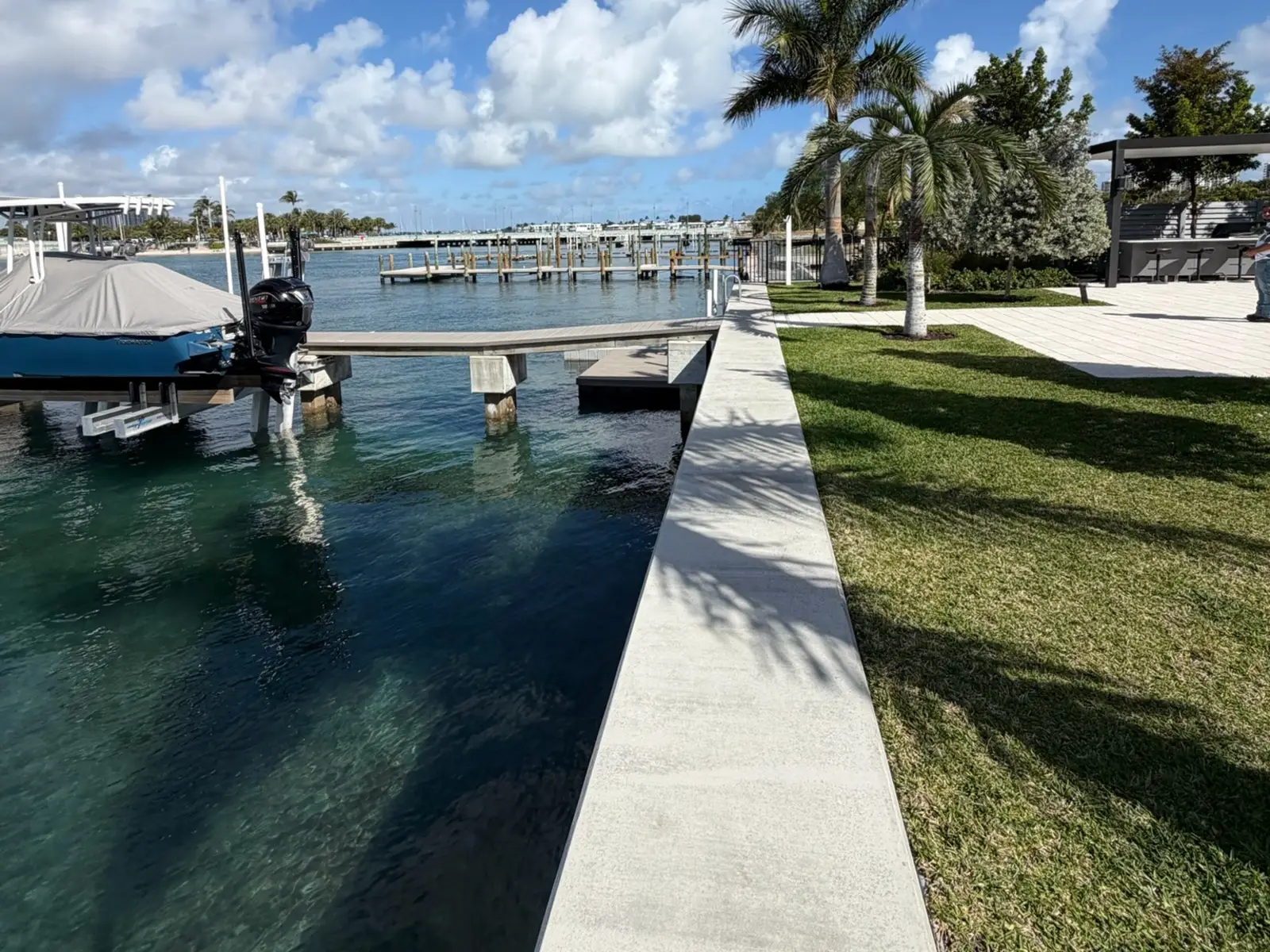
A seawall has two jobs: hold the water out and hold the land in. Most owners only think about the first one. Erosion behind a seawall is what happens when the second job starts to fail, and it usually shows up in the yard long before anything looks wrong from the water.
On South Florida canals the pattern is familiar. A soft spot appears in the grass a few feet from the cap. You fill it, and a few months later it is back, sometimes bigger. Pavers along the wall begin to dip. After a heavy rain you notice a fan of sand in the water at the base of the wall. None of these is a crisis on its own, but together they mean soil is leaving your property through an opening in the wall, and the wall is slowly losing the support that keeps it upright.
This guide covers why that happens, how to read the warning signs, which repairs actually close the leak, and when the answer is a new wall rather than another patch. If you already know you need help, our seawall repair team handles void filling, joint sealing, and structural repairs across Broward and Palm Beach County.
Why soil washes out from behind a seawall
A typical concrete panel seawall is a row of slabs driven into the canal bottom, tied back to anchors in the yard, and finished with a poured cap. The space behind the panels is backfilled with soil. Between each panel is a vertical joint, and the wall is built with weep holes and, on many walls, a French drain so rainwater and groundwater can drain out without building up pressure behind the slabs (City of Holmes Beach Seawall Manual).
Those joints and drains are necessary, but each one is also a place where soil can escape. At construction, filter fabric is placed behind the joints and weep holes so water can pass while the fill stays put. When that system breaks down, water moving in and out with the tide carries fine sand with it. The most common pathways are:
- Open or separated panel joints. As walls age and settle, the seams between slabs widen, and fill migrates through the gap into the canal.
- Failed or missing filter fabric. Once the fabric behind a joint tears, shifts, or deteriorates, nothing is left to hold the sand back.
- Cracks in the panels. Cracks from corroding steel or wall movement become new openings, especially below the waterline where you cannot see them.
- Clogged weep holes and drains. When drainage stops working, water builds up behind the wall after rain and pushes harder on the panels, and it finds its own way out, usually through a joint.
- Toe and berm loss. Wave action and boat wake can scour the berm at the bottom of the panels. Once the toe is undermined, soil can run out underneath the wall, and the wall itself can start to kick out.
- Stormwater pipes through the wall. Poor sealing around a drain outfall creates a direct path for soil to follow the pipe out.
The Holmes Beach manual, one of the clearest owner-facing guides published by a Florida city, notes that slab separation lets backfill migrate through the openings and that this frequently occurs after heavy rains. That matches what we see after a South Florida rainy season: the sinkholes show up in late summer and fall.
Why South Florida walls see more of it
Three local conditions make this worse here. First, our backfill is mostly loose sand, which moves easily once water finds a path. Second, many canal walls in Broward and Palm Beach County are decades old, and filter fabric and joint seals do not last as long as the concrete panels around them. Third, water levels are higher and wetter more often. NOAA describes high tide flooding as increasingly common along the coast as sea levels rise, with water reaching above normal high tide even on sunny days (NOAA Ocean Service). More water against the wall, more often, means more cycles of water flowing in and out through the same weak joints.
Boat traffic matters too. Wake from busy stretches of the Intracoastal and wide canals works on the berm at the bottom of the wall. Properties on bends and near inlets tend to see faster toe scour than those on quiet dead-end canals.
Warning signs to look for
Walk the wall at low tide once in a while. Most of the evidence is visible from the yard or the dock if you know what to look for:
- Depressions or sinkholes in the lawn or landscaping a few feet behind the cap, often lined up with a panel joint.
- Holes that come back after you fill them. This is the clearest sign the pathway is still open.
- Sand or rock mounded in the water at the base of a joint, most visible at low tide.
- Pavers, pool decks, or walkways settling near the wall, or cracks in slabs that run parallel to it.
- Gaps you can see into between panels, or light and water visible through a joint.
- A cap that is tilting or separating from the panels. That usually points to a structural problem beyond soil loss, which we cover in our seawall cap repair guide.
A single soft spot is an early warning. Several, or one that keeps reopening, means the void behind the wall is larger than the hole you can see, because the surface is usually the last part to collapse. A professional seawall inspection can probe the soil along the wall, check the joints below the waterline, and tell you how far the problem extends.
Why filling the hole is not a repair
Topping up a sinkhole with soil or sand is a reasonable way to keep someone from twisting an ankle, and there is nothing wrong with doing it while you arrange an assessment. It is not a fix. The new fill is just as loose as the old fill and the opening that let it escape has not changed, so the next spring tide or heavy rain starts carrying it out again. Owners sometimes do this for years while the void under the surface keeps growing and the panels lose more of the soil pressure that balances them against the water side.
The goal of a real repair is to close the path the soil is leaving through and then restore the soil mass behind the wall.
Repair options, from simplest to most involved
The right repair depends on where the soil is escaping and whether the wall itself is still sound. These are the approaches most often used, and they are frequently combined:
Sealing joints and cracks, and replacing filter fabric. Where the wall is in good shape and the leak is at specific seams, the joints can be sealed and new filter fabric installed behind them, with the backfill replaced and compacted. The Holmes Beach manual lists sealing seams and cracks and installing filter fabric as the standard remedy for joint separation.
Restoring drainage. Clearing clogged weep holes, replenishing the rock in a French drain, or adding supplemental drainage relieves the water pressure that pushes soil through the wall after rain. Drainage work is often overlooked, and it is one reason some joint repairs fail again.
Polyurethane injection. For voids behind a wall with sound panels, contractors inject a hydrophobic polyurethane through probes set in the soil. NCFI, one of the manufacturers, describes seawall foam repair as sealing the pathway the water is escaping through and rebuilding the soil mass supporting the panel, without excavation or dewatering (NCFI). The main advantage is that it can be done without tearing up a finished yard, pool deck, or landscaping. You can see one of these jobs in our Boca Raton NCFI injection project.
Rebuilding the toe. When the berm at the bottom of the panels has scoured away, the fix is on the water side: replacing the berm, placing riprap, or similar measures to stabilize the base of the wall. Riprap also slows the water hitting the wall, though it can reduce usable depth at the dock.
Replacing the wall. Injection and joint work are maintenance repairs. They do not fix panels that are cracked through, tie-backs that have failed, or a wall that is leaning or kicking out at the toe. When the structure is failing, soil loss is a symptom, and the repair is a new or rebuilt wall. Our seawall cost guide explains what drives the price of that kind of project.
Permits and Broward's seawall rules
Small maintenance repairs to an existing wall are often covered by Florida's environmental resource permitting exemptions, which include certain repair, replacement, and restoration of seawalls in the same location and seawall work in artificial waterways (Rule 62-330.051, F.A.C.). Whether your job qualifies depends on its exact scope, and your city will usually still require a building permit, so this is something your contractor should confirm rather than assume.
Broward County adds a second layer. Its model resilience ordinance, which tidally influenced cities were required to adopt, sets a minimum top elevation for new and substantially repaired seawalls and seawall caps. It also requires owners to keep their seawall in good repair: a wall that lets tidal water flow unimpeded through or over it onto neighboring property or the right-of-way is presumed to be in disrepair, and that can lead to a citation with deadlines to repair (Broward County Regional Resilience Standard). An open joint that is washing out your yard is often the same opening that lets king tides in, so fixing erosion early helps on both fronts.
When to call someone
Call for an assessment if a sinkhole keeps reopening, if you see soil in the water at the base of the wall, or if more than one area along the wall is settling. Call quickly if the cap is tilting, the wall is visibly leaning, or a crack runs through a panel, because those point to structural movement rather than a simple leak. Early repairs are usually smaller repairs: sealing a joint and filling a void is a far lighter job than rebuilding a wall that has been losing its backfill for years.
South Florida Seawall inspects and repairs seawalls from Fort Lauderdale to Boca Raton and Delray Beach. Send us photos of the soft spots and the wall face at low tide through our contact page or call 754-SEA-WALL, and we will tell you what we see and what the next step should be.
Sources
- City of Holmes Beach — Seawall Manual (sinkholes, joint separation, toe and berm failure, drainage)
- NCFI — Soil Stabilization and Seawall Repair with Geotechnical Polyurethane
- Florida Administrative Code Rule 62-330.051 — Exempt Activities (Environmental Resource Permitting)
- Broward County — Regional Resilience Standard for Seawalls and Shorelines (Chapter 39, Article XXV)
- NOAA Ocean Service — What is high tide flooding?